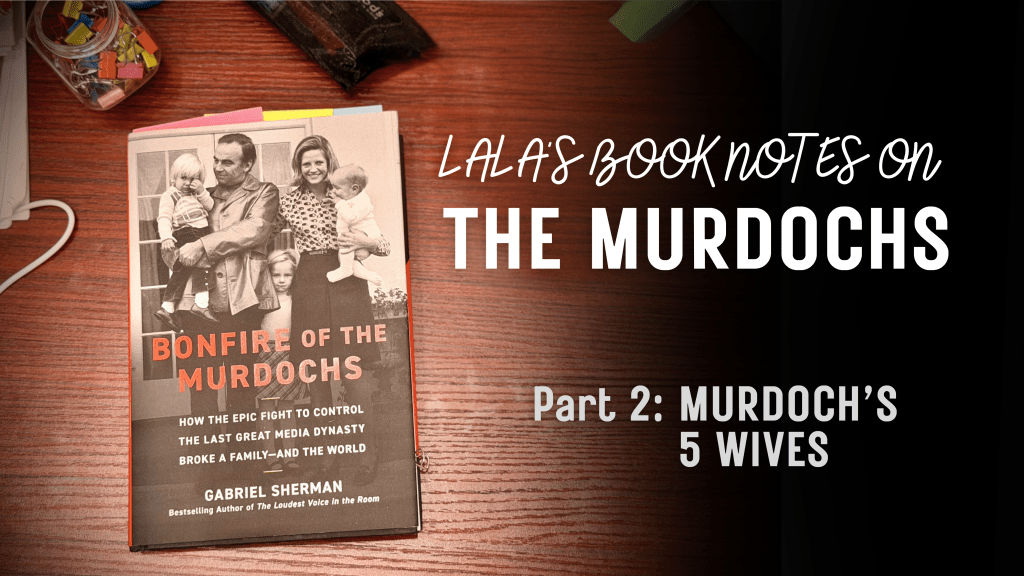
In the sprawling saga of the Murdoch dynasty, marriage was never merely a romantic pursuit; it was a strategic merger reflecting the shifting ambitions of the “Sun King” himself.
As detailed in Gabriel Sherman’s explosive biography, Bonfire of the Murdochs (Simon & Schuster, 2026), Rupert Murdoch’s 5 wives—Patricia Booker, Anna Torv, Wendi Deng, Jerry Hall, and Elena Zhukova—each served as a distinct marker in the timeline of his global conquest. From the modest beginnings of an Australian newspaper baron to the twilight years of a frail patriarch suing his own children in court, Murdoch’s treatment of his spouses followed a ruthless pattern: they were acquired when useful, utilized as stabilizers, status symbols, or companions, and liquidated with cold efficiency when they became sources of friction.
Sherman illustrates that for Murdoch, intimacy was often just another commodity subject to market forces. Whether it was the “casualty of conquest” that was Patricia Booker during the initial Australian expansion, the “Catholic conscience” of Anna Torv that stabilized the empire’s global rise, the “gale-force” ambition of Wendi Deng that signaled his pivot to China and technology, or the “mechanical” necessity of Elena Zhukova to witness his final act, Murdoch’s marriages mirrored his business cycles.
Yet, as the brutal email dismissal of his fourth wife, Jerry Hall—”Jerry, sadly I’ve decided to call an end to our marriage… I have much to do”—demonstrates, Murdoch governed his heart with the same Darwinian ruthlessness he applied to his newsrooms: when an asset stops performing, you divest.
1. PATRICIA BOOKER: The casualties of conquest
Background: The ‘modest’ beginning
Before she was a Murdoch, Patricia Booker was a woman of “modest” means living in Adelaide, Australia. A blonde flight attendant and part-time model, she represented a life far removed from the establishment aristocracy that Rupert Murdoch’s mother, Dame Elisabeth, inhabited. Patricia was not looking for a tycoon. In fact, she initially found the young Rupert unappealing. “I didn’t know who Rupert Murdoch was, and I didn’t really like him very much at all,” she later admitted.
Motivation and marriage: The persistence of ‘The Boy Publisher’
Patricia’s motivation was never wealth or status; she was worn down by Rupert’s sheer persistence. In 1954, Rupert was the 23-year-old “Boy Publisher,” desperate to prove himself. He saw in Patricia a prize to be won, a beautiful woman who fit his budding image as a man on the rise. Despite her initial rejection of his request for a date, he kept pursuing her until she relented.
They married in 1956. The union was immediately contentious within the Murdoch hierarchy. Dame Elisabeth, Rupert’s domineering and status-conscious mother, was “dismayed” by the match, viewing Patricia as unsuitable for the Murdoch lineage. This external disapproval set the tone for Patricia’s isolation within the marriage.
The wife and mother: Living with a ghost
Patricia’s experience as Mrs. Rupert Murdoch was defined by neglect. Rupert was in the throes of his “conquest” phase, buying newspapers in Perth, Darwin, and Sydney. He freely admitted later, “I was totally involved in the business—probably very inconsiderate.”
- As a wife: Patricia was essentially a widow to Rupert’s ambition. As Rupert spent weeks away expanding his empire, Patricia was left alone in Adelaide. The isolation drove her into a deep depression. She was not a partner in his business but a bystander to his obsession.
- As a mother: Patricia gave birth to Prudence (“Prue”) in 1958. However, her ability to parent was compromised by her deteriorating mental health and the chaotic lifestyle Rupert imposed. Prue recalled a childhood devoid of routine, where instead of going to school, the parents would say, “No! Let’s all go to the races!”. This instability was a symptom of a household where “fun” masked deep dysfunction.
The end and the pattern
By the mid-1960s, Rupert had outgrown Adelaide and, by extension, Patricia. He justified his parental and marital failings as “the price of conquest”. The marriage ended in 1967 when Rupert met Anna Torv. The divorce was “sad and bitter.”
Rupert’s pattern with Patricia: Patricia established the foundational pattern of Rupert’s romantic life: The wife is expendable. When she could no longer keep pace with his expansion or provide the social utility he needed, she was discarded.
Following the divorce, Patricia’s life disintegrated. She married a “heavy-drinking Adelaide hairdresser” named Freddie Maeder, fell into deeper depression, and spent the rest of her life supported by Rupert in a modest flat, while he ascended to global fame.
2. ANNA TORV: The architect of the empire (and its destruction)
Background: The ‘seductive’ journalist
Anna Torv was everything Patricia was not: intellectual, ambitious, and professionally connected to Rupert’s world. Born in Scotland and raised in Australia, she was a 19-year-old reporter for Rupert’s Daily Mirror in Sydney when they met in 1962. Half-Scottish and half-Estonian, she was a devout Catholic with a strong moral code. She caught Rupert’s attention with her “steely blonde” looks and her sharp mind. “He was like a whirlwind coming into the room. It was very seductive,” she recalled.
Motivation: The civilizing force
Anna’s motivation was to create a “normal” life within an abnormal dynasty. She believed she could domesticate Rupert. She valued culture, travel, and literature, whereas Rupert cared only for business and politics. She hoped to refine him, to make him a “gentleman” rather than just a corporate raider.
The wife and mother: The stabilizer
For over 30 years, Anna was the bedrock of the Murdoch family.
- As a wife: She was the “Catholic conscience” of the empire. She despised the “Page 3” nudity in The Sun and the sleaze of News of the World, arguing with Rupert that he couldn’t “teach the boys respect for women” while publishing pornography. She was his entry point into polite society, hosting dinners for Prime Ministers and soothing the egos of executives Rupert had bruised. However, she struggled with his ruthlessness. When Rupert betrayed his mentor Clay Felker to buy New York magazine, Anna was socially isolated in the Hamptons, humiliated by her husband’s treachery.
- As a mother: She raised Elisabeth, Lachlan, and James (and step-daughter Prue). She tried to instill humility, forcing them to work summer jobs and warning them against greed. “I thought that responsibility would teach each of you humility. I was wrong. It taught you greed and disloyalty,” she wrote in a novel, using fiction to speak the truth she couldn’t say at the dinner table.
- As a writer: Stifled by Rupert’s dominance, Anna turned to writing novels (In Her Own Image, Family Business). These books were thinly veiled critiques of the Murdoch dynasty, featuring patriarchs who die and leave their families in chaos—a prophetic warning Rupert ignored.
The end: The ‘poison pill’
By the late 1990s, Anna wanted Rupert to slow down. She dreamed of them retiring, taking courses in creative writing, and enjoying their wealth. Rupert viewed retirement as death. “What about the household?” he asked dismissively when she suggested she study writing.
The marriage collapsed when Rupert fell for Wendi Deng. Anna was blindsided. “I thought we had a happy marriage,” she told a friend. When she confronted him, he was cold. “It’s not an original plot,” she noted bitterly.
Rupert’s pattern with Anna: Rupert stayed with Anna for decades because she provided the stability he needed to build his empire. When he achieved global dominance, he no longer needed a stabilizer; he needed a rejuvenator. He discarded Anna for a younger model (Wendi) who reflected his new obsession with China and technology.
The ultimate revenge: Anna is the most consequential wife because of her divorce settlement. She accepted a smaller payout ($100 million vs. a potential $2 billion) in exchange for the creation of the Family Trust. This trust gave her 3 children (and Prue) irrevocable voting rights upon Rupert’s death. It was a “poison pill” designed to prevent Rupert from disinheriting her children in favor of his new family. It is this legal mechanism that forced Rupert to sue his own children in 2024.
3. WENDI DENG: The Tiger Wife
Background: The American dreamer
Wendi Deng was born in Xuzhou, China, in 1968, during the Cultural Revolution. Her name originally meant “Cultural Revolution,” which she later changed. She was a survivor. She learned English from an American couple, the Cherrys, and convinced them to sponsor her student visa to the US. She then had an affair with the husband, Jake Cherry (breaking up his marriage), to secure her Green Card. Wendi was a Yale MBA student with a “gale-force personality.” She landed an internship at Star TV in Hong Kong, where she was the only one brave enough to challenge Rupert.
Motivation: Ambition and vitality
Wendi’s motivation was advancement. She was “bold, provocative, and unafraid to be the alpha.” When Rupert visited Star TV and complained about the strategy, Wendi—a lowly intern—stood up and shouted, “Why is your business strategy in China so bad?”. Rupert was captivated. She represented the future: China, youth, and fearlessness.
The wife and mother: The disrupter
Wendi did not want to be a trophy wife; she wanted to be a co-CEO.
- As a wife: She was actively involved in the business, advising on MySpace and Chinese investments. She acted as Rupert’s gatekeeper and stylist, dying his hair and dressing him in Prada. However, the dynamic was volatile. She was abusive, calling him “old” and “stupid.” In one infamous incident, she shoved him into a piano, fracturing his vertebrae. Yet, she also fiercely protected him, famously leaping to slap a protester who threw a pie at Rupert in Parliament in 2011.
- As a mother: She had two daughters, Grace and Chloe. Wendi was a “Tiger Mom,” restricting their food (“skinny like Zhang Ziyi”) and demanding academic excellence. Her obsession was securing their place in the Family Trust. She fought Rupert for years to give them voting rights, causing a massive rift with the older children (Lachlan, James, Liz).
The end: The spy and the prime minister
The marriage imploded due to two factors:
- Suspicion: Rumors circulated within News Corp that Wendi was a Chinese intelligence asset. Rupert grew paranoid.
- Betrayal: Wendi developed a crush on Tony Blair, the former UK Prime Minister and Rupert’s close ally. Rupert found Wendi’s diary entries praising Blair’s “good body” and “piercing blue eyes.” Staffers reported Wendi and Blair feeding each other at the ranch.
Rupert’s Pattern with Wendi: Rupert filed for divorce in 2013 without telling her. He “blindsided” her, just as he had blindsided his business enemies.
This fit his pattern: Preemptive Strike. When a wife becomes a liability (reputational or emotional), he executes a cold, calculated removal.
4. JERRY HALL: The trophy and the nurse
Rupert’s pattern with Jerry: The wife as an employee. When her contract was up—when her utility as a nurse and status symbol was outweighed by the “hassle” she caused with the children—she was fired. The email breakup highlights Rupert’s total inability to handle emotional confrontation. He treats personal relationships as transactions that can be terminated remotely.
Background: The rock ‘n’ roll model
Jerry Hall was a Texan supermodel and the long-time partner of Mick Jagger. She was a global icon of the 1970s, known for her “leggy” beauty and fun-loving personality. By 2015, she was in her late fifties, playing Mrs. Robinson in The Graduate on stage in Melbourne.
Motivation: Safety and status
For Jerry, marrying Rupert (who was 25 years her senior) offered security and a final act of high-status living. For Rupert, Jerry was the ultimate trophy—a woman who had been with the coolest man on earth (Jagger) but chose him. It stroked his ego to steal a rock star’s girl. “Mick was so unfaithful to you, I’d never be unfaithful,” he told her.
The wife and stepmom: The gatekeeper
- As a wife: Jerry doted on Rupert. She was “kind, gentle,” and focused on his health. During the COVID-19 pandemic, she became his nurse, isolating him in Bel Air to keep him alive. She baked bread, played backgammon, and enforced strict mask protocols.
- The conflict: Her protectiveness became her undoing. Rupert’s children, particularly Lachlan, viewed her as a barrier. They felt she was “gatekeeping” access to their father. Jerry also clashed with them politically; she was a liberal who despised Donald Trump, while Lachlan and Rupert were pushing Fox News further right. “Jerry is a danger to the company,” Lachlan reportedly felt.
The end: The email
The end of Jerry Hall’s marriage is perhaps the cruelest example of Rupert’s detachment. In June 2022, Jerry was waiting for Rupert to join her in London. Instead, she checked her phone and found an email: “Jerry, sadly I’ve decided to call an end to our marriage… We have certainly had some good times, but I have much to do… My New York lawyer will be contacting yours immediately”. Rupert had decided she was “friction.” She had served her purpose (COVID survival, status), but now she was annoying his heir, Lachlan.
5. ELENA ZHUKOVA: The final companion
Background: The scientist
Elena Zhukova is a retired molecular biologist and scientist. Sixty-six years old when they met, she is the mother of Dasha Zhukova, a prominent socialite and art collector. In a twist of the Murdoch social web, Elena and Rupert met through Wendi Deng, who was friends with Elena’s daughter.
Motivation and marriage: The mechanical move
The relationship began in August 2023, barely five months after Rupert had called off a disastrous two-week engagement to Ann Lesley Smith (a dental hygienist turned radio host who spoke of “right-wing conspiracy theories”). At 92, Rupert’s “pattern of blithely moving on had become almost mechanical”. He married Elena in June 2024.
The wife: The silent witness
Elena’s role appears to be that of the silent companion for the final act.
• The trial: In September 2024, when Rupert arrived at the Reno courthouse to sue his children, it was Elena who walked beside him. She was “trailed by a phalanx of security guards” as she accompanied the frail, 93-year-old patriarch into the building.
• The dynamic: Unlike Wendi (who fought for business control) or Jerry (who fought for his health), Elena seems to serve as a witness to his existence. Her presence suggests that Rupert Murdoch, despite his immense power, possesses a deep inability to be alone.
Rupert’s pattern with Elena: The king cannot be alone
Even while destroying his family in court, Rupert required a wife by his side. Her presence at the trial highlights the isolation of his position: he was there with his 5th wife to fight the children of his 2nd wife, while the children of his 1st wife watched from the opposition bench.
——————————————————————————–
Summary : The Murdoch wives
- Sameness vs. difference:
- Patricia was the mistake of youth. Too modest.
- Anna was the corrective. The intellectual equal and stabilizer.
- Wendi was the midlife crisis. The injection of youth and Asian expansion.
- Jerry was the twilight comfort. The trophy nurse.
- Elena was the mechanical necessity. The silent scientist for the final act.
- Commonality: Utility over intimacy:
- All 4 ex-wives were eventually discarded when their personal needs or desires conflicted with the business or the patriarch’s comfort. Rupert’s relationship with Elena, formed when his pattern of moving on had become “almost mechanical,” suggests a man who cannot face the end of his life alone, ensuring a companion is present even as the family disintegrates around him
- Rupert’s treatment pattern:
- Compartmentalization: Rupert separates “Business” from “Family,” but eventually, Business consumes Family.
- The “blindside”: He rarely confronts his wives. He cheats (on Anna), files secretly (on Wendi), or emails (Jerry). He lacks the courage for emotional honesty.
- Asset liquidation: He stays as long as the wife serves a function (raising heirs, expanding into China, keeping him healthy). Once that function is fulfilled or obstructed, the marriage is liquidated like a failing subsidiary. With Elena, the function appears to be simply ensuring he does not have to face the end of his life—and the judgment of his children—alone.
Check the other posts in this BOOK NOTES on the Murdochs:
- LALA’S BOOKNOTES: Bonfire of the Murdochs: How the epic fight to control the last great media dynasty broke a family—and the world, by Gabriel Sherman
- RUPERT MURDOCH: The man who wanted everything
- MURDOCH’S 5 WIVES: Managing a portfolio of mergers and liquidations
- LACHLAN MURDOCH: A comprehensive profile of ‘the last prince’
- JAMES MURDOCH: The Redemption of ‘the Rebel Heir’
- ELISABETH ‘LIZ’ MURDOCH: A comprehensive profile of ‘the exiled queen’
- PRUE MURDOCH: A comprehensive profile of ‘the ghost in the room’

 Lala Rimando
Leave a comment