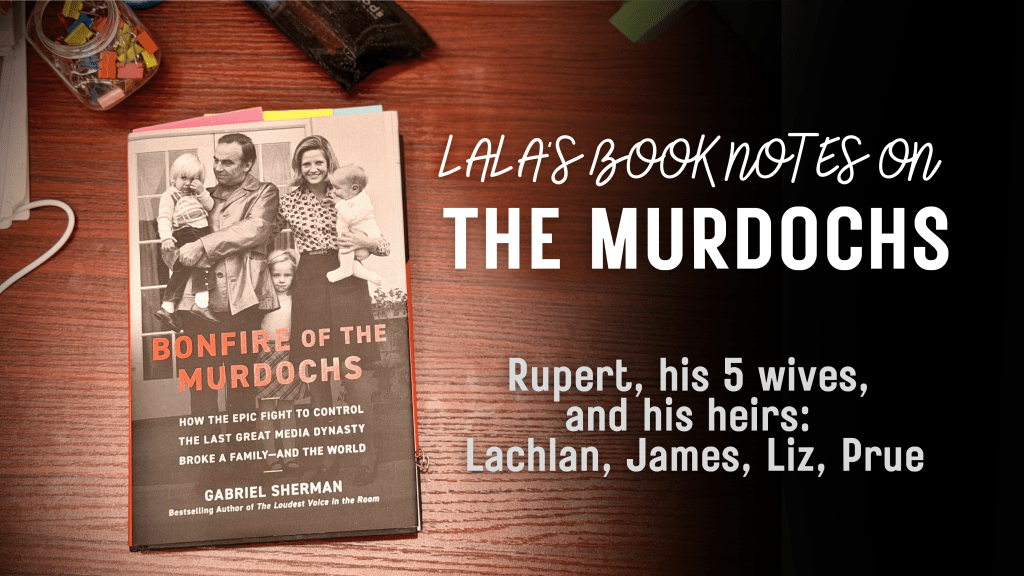
In one sentence
Rupert Murdoch used a ruthless, “Darwinian” approach to build a $17 billion global media empire that permanently reshaped politics, while acting as a King Midas who incinerated his own marriages and pitted his children against each other in a tragic battle for succession.
Key takeaways
- The Midas curse: Murdoch turned everything he touched into gold ($17 billion), but amassing that wealth required him to damage the environment, truth, democracy, and ultimately, his own family.
- Control is the ultimate metric: Above all else, Murdoch’s core operating principle is absolute voting control; he engineered his company structure so he would never be at the mercy of a public board or banks.
- A “Darwinian” father: He viewed family through a transactional lens, deliberately pitting his children (Lachlan, James, Liz) against each other in a lifelong “blood sport” to see who was ruthless enough to inherit the throne.
- The ideology of “green”: While he built the world’s most powerful right-wing propaganda machine (Fox News, The Sun), his true ideology is profit. He rationalizes broadcasting lies (like the 2020 election conspiracy) because “it is not red or blue, it is green”. Green = US dollar. Profit.
- Wives as corporate divisions: Murdoch acquired wives who suited specific “eras” of his ambition (expansion, China pivot, twilight survival) and coldly liquidated them via blindside filings or emails when they became “friction”.
- The “Boy King” template: Decades before Silicon Valley moguls operated with total impunity, Murdoch created the archetype of the unaccountable CEO who treats a public company like a personal fiefdom.
Summary
This biography serves as both a “meditation on power” and a dark family psychohistory, tracing Rupert Murdoch’s life from a lonely boy in Australia to a 93-year-old titan fighting his children in a Nevada courtroom. Driven by the ghost of his distant father and the brutal “sink or swim” lessons of his mother, Rupert turns a small Adelaide newspaper into a global colossus encompassing Fox News, The Wall Street Journal, and Fleet Street tabloids.
A major throughline is Murdoch’s “catlike cunning” and lack of sentimentality. He identifies vulnerable assets, charms their owners with promises of editorial independence, and immediately shreds those promises upon taking control. His empire expands rapidly on massive debt and transactional political alliances, trading favorable media coverage for regulatory favors from leaders like Margaret Thatcher, Tony Blair, and Donald Trump.
Alongside his corporate conquests is the wreckage of his personal life. Murdoch treats intimacy as a tactical vulnerability. He is deeply conflict-averse in private, famously forcing his daughter Liz to fire his son James during the 2011 Phone Hacking Scandal, and dumping his fourth wife, Jerry Hall, via a two-sentence email. The book culminates in “Project Family Harmony,” the Orwellian-named 2024 legal battle where Rupert attempts to rewrite his irrevocable family trust to disempower his centrist children and hand the keys exclusively to his conservative eldest son, Lachlan.
My notes & reflections
What stands out is how deeply Rupert’s childhood trauma informed his business playbook. His mother famously threw him into a cruise ship pool to teach him to swim while he screamed and flailed—a brutal lesson that “no one is coming to save you”. He simply passed this trauma down, throwing his children into the corporate “pool” to see who would drown.
The Twitter/X and Silicon Valley parallels are chilling. Long before Elon Musk or Mark Zuckerberg, Murdoch realized that “sucking up to power” and monetizing outrage could be scaled industrially without accountability. He proved that outrage is the most reliable commodity.
Book author Sherma does not paint him as a mastermind playing 4D chess, but rather as a “Great White Shark” who must keep swimming to survive. He is strangely endearing in his simplicity (carrying his own bags, wearing rumpled suits, having no hobbies besides business), yet terrifying in his capacity to rationalize the destruction of democracies just to keep his cable ratings high. The final Reno settlement is the perfect tragic ending: he pays his children $1.1 billion each to go away, winning his company but losing his family forever.
Who should read this book
- Fans of HBO’s Succession who want to see how the real-life inspiration is actually much weirder and more tragic.
- Journalists, founders, and media operators seeking to understand the mechanics of power, tabloid journalism, and global dealmaking.
- Anyone interested in the psychological roots of political polarization and how figures like Roger Ailes and Donald Trump were enabled by corporate pragmatism.
Favorite quotes
- “It is not red or blue, it is green.” (On why he allowed Fox News to air 2020 election lies to stop viewers from fleeing).
- “He turns on lovers and chops them off.” (A former executive on Rupert’s M.A.).
- “We are in the entertainment business.” (His response after his paper published the forged Hitler Diaries).
- “Jerry, sadly I’ve decided to call an end to our marriage… I have much to do.” (The email ending his marriage to Jerry Hall).
- “It’s money that wins this kind of scrap.” (To his mentor Clay Felker as he launched a hostile takeover of his magazine).
- “I have to think of my children.” (Rupert’s frequent excuse for consolidating power, masking his own ambition).
FAQ
Is the real family actually like the show Succession? Yes, but darker. A family member told the author that while the show is good, the reality is “much weirder” Rupert is not the loud, booming Logan Roy; he is quiet, conflict-averse, and mumbles, making his betrayals (like using one child to fire another) even more chilling.
Why did Rupert sue his own children in 2024? To protect the right-wing legacy of Fox News. His irrevocable family trust gave his four eldest children equal voting power upon his death. Fearing that his three more liberal children (James, Liz, Prue) would outvote his conservative heir (Lachlan) and moderate the network, Rupert sued them to strip their voting rights in a case ironically named “Project Family Harmony.”
What was the “Dominion Betrayal”? After the 2020 election, Rupert privately knew Trump’s stolen election claims were “bullshit.” However, when viewers started abandoning Fox News for calling Arizona correctly, Rupert panicked and allowed his hosts to peddle conspiracy theories to save the stock price. This decision cost the company $787 million in a defamation settlement, which Rupert viewed merely as a business expense.
How did he treat his wives? Like corporate subsidiaries. He had 5 wives, acquiring them for specific “eras” of his ambition (Anna for empire-building, Wendi Deng for his China/tech pivot, Jerry Hall as a COVID nurse). When they asked him to slow down or became a liability, he discarded them, often via email or blindside filings.
Thematic breakdown
The original trauma and grievance
- Rupert grew up trying to earn the respect of his heroic but distant father, Sir Keith, whose claim to fame was breaking military censorship rules to report the truth at Gallipoli.
- Mocked by the elites as a “Boy Publisher” when he inherited a tiny paper after his father’s death, Rupert was driven by a lifelong grievance to burn down the establishment and cast a “longer shadow” than his dad.
The playbook: Acquisition and betrayal
- The Trojan Horse: Charm an aristocratic or complacent owner, promise to maintain their legacy and editorial independence, acquire the asset, and immediately fire the staff and pivot to populism (used on News of the World, The Times, and The Wall Street Journal),.
- Transactional politics: Use newspapers as cudgels. He endorsed politicians (Ed Koch, Margaret Thatcher, Tony Blair) purely to gain regulatory favors, like breaking unions or bypassing antitrust laws.
The Darwinian father
- He believed a brutal competition would forge the best successor.
- Lachlan (The Heir): The golden child who shared his politics but lacked his killer instinct. He quit the company in 2005 due to Rupert’s lack of support, forcing Rupert to spend a decade wooing him back as a “caretaker.”
- James (The Scapegoat): The intellectual who tried to modernize the company, only to be offered up as a human shield during the devastating 2011 Phone Hacking Scandal.
- Liz (The Sidelined Talent): The sharpest executive who was ignored due to Rupert’s “old-fashioned primogeniture,” forcing her to build her own company to win his respect.
The Midas Curse (The Endgame)
- By the end of his life, Rupert had everything he wanted: Fox News was the most powerful network in America, his family was worth $17 billion, and Lachlan was seated on the throne.
- However, the cost was the total alienation of his other children, multiple destroyed marriages, and a legacy tied to the destabilization of Western democracy. He won the game, but ended up completely alone.
Check the other posts in this BOOK NOTES on the Murdochs:
- LALA’S BOOKNOTES: Bonfire of the Murdochs: How the epic fight to control the last great media dynasty broke a family—and the world, by Gabriel Sherman
- RUPERT MURDOCH: The man who wanted everything
- MURDOCH’S 5 WIVES: Managing a portfolio of mergers and liquidations
- LACHLAN MURDOCH: A comprehensive profile of ‘the last prince’
- JAMES MURDOCH: The Redemption of ‘the Rebel Heir’
- ELISABETH ‘LIZ’ MURDOCH: A comprehensive profile of ‘the exiled queen’
- PRUE MURDOCH: A comprehensive profile of ‘the ghost in the room’
 Lala Rimando
Leave a comment