Elisabeth Murdoch spent her life battling a single, immutable fact: in her father’s eyes, kings are succeeded by princes, not princesses.
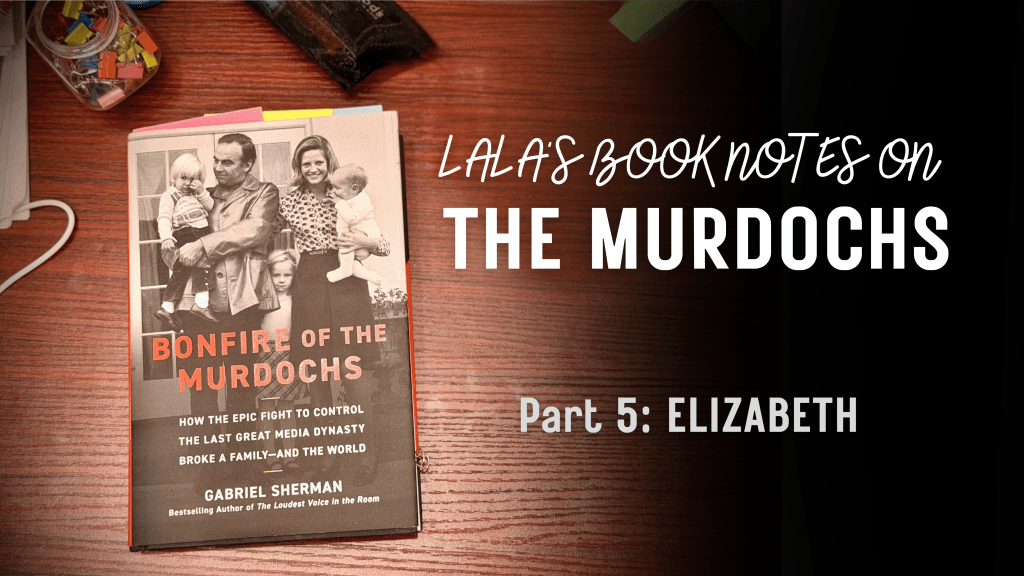
Gabriel Sherman’s Bonfire of the Murdochs (Simon & Schuster) portrays Liz as arguably the most naturally gifted executive of the clan—a woman who possessed Rupert Murdoch’s killer instinct and social charm in equal measure. Yet, unlike her brothers Lachlan and James, who were handed empires to run, or her father’s wives who were treated as assets, Liz was forced to build her own billion-dollar kingdom, Shine, just to force her father to look at her with professional respect.
This profile examines the ‘Switzerland’ of the family, a woman who tried to broker peace between warring factions while navigating the ‘old-fashioned primogeniture’ that doomed her ambition from the start.
——————————————————————————–
The best man for the job was a woman
On the crisp morning of September 16, 2024, Elisabeth “Liz” Murdoch stepped out of a white SUV in front of the Washoe County Courthouse in Reno, Nevada. At 53, she wore a beige suit with the “poise of a businesswoman who spent decades fighting to be taken seriously”. Unlike her brother James, who wore his rebellion like a scar, or Lachlan, who wore his entitlement like armor, Liz projected a terrifying competence. She was there to fight her father, Rupert Murdoch, in a secret trial to determine the future of the empire she had once hoped to lead.
For decades, media analysts, shareholders, and family intimates had whispered the same conclusion: Liz was the “sharpest” of the Murdoch children. She was the most naturally gifted executive, the one who possessed Rupert’s “mercurial, combative, and gossip-loving” personality. She was the only one to build a billion-dollar media company from scratch without her father’s direct hand. Yet, she was disqualified from the moment of her birth by a single, immutable fact: her gender. Rupert Murdoch subscribed to “old-fashioned primogeniture”. In his world, kings were succeeded by princes, not princesses.
To understand Liz Murdoch is to understand the tragedy of competence denied. She is “The Independent” who built her own kingdom to force her father to respect her, only to sell it back to him in a bid for intimacy that ultimately failed. She is the “Switzerland” of the family who tried to broker peace between her warring brothers, only to realize that neutrality is impossible in a burning house. This profile explores the life of the woman who spent 50 years trying to prove she was equal to the boys, only to walk away with $1.1 billion and the bitter knowledge that to her father, she was always just the daughter.
——————————————————————————–
Origins: The girl who would be king
The “sharp-tongued” striver : Elisabeth was born in Sydney in 1968, the first child of Rupert Murdoch’s marriage to the journalist Anna Torv. From the beginning, she was squeezed between the trauma of her half-sister Prudence (from Rupert’s first marriage) and the arrival of the “Golden Child,” Lachlan, in 1971.
While Lachlan was anointed by birthright and James by intellect, Liz carved out her space through sheer force of personality. She was “sharp-tongued and fearless,” a child who refused to be overlooked simply because she was female. At the Aspen ski chalet where the family spent holidays, the dynamic was brutal. The children competed for Rupert’s love through “chin-up contests that left Lachlan’s and James’s palms bleeding” and game nights that devolved into shouting matches. Liz didn’t just participate; she fought to win. “Liz [was] the most overtly ambitious of the three kids,” a former News Corp executive noted. “She was driven to prove to her dad that she could more than hold her own with the boys”.
Vassar and the rebellion : Like her siblings, Liz was sent to American boarding schools (The Brearley School in NYC) and eventually landed at Vassar College in 1986. At Vassar, she displayed a pattern that would define her adult life: the ability to seamlessly blend into the cultural elite while retaining the Murdoch edge. She ran with the “cool crowd,” befriending future fashion designer Carolina Herrera and filmmaker Noah Baumbach. She worked as a waitress at the Dutch Cabin to prove she wasn’t a spoiled heiress, yet she wrote her senior thesis on In Her Own Image, a novel written by her own mother, Anna.
Her first marriage was an act of defiance. In 1993, she married Elkin Pianim, a Ghanaian graduate student and son of a prominent political dissident. It was a union that combined “Christian and African traditions,” but Rupert and Anna barred the media from the event, a sign of their discomfort. When a friend threatened to attend, Anna snapped, “I am much tougher than Rupert and I’m telling you that now… considering the intrusions into privacy which all his newspapers have gloried in for years”.
——————————————————————————–
The businesswoman: The pattern of rejection and reinvention
The BSkyB crucible : Liz’s entry into the family business was not a coronation; it was a hazing. After a stint at FX in Los Angeles, she moved to London in 1996 to become head of broadcasting for BSkyB (Sky).
• The Conflict: She clashed instantly with CEO Sam Chisholm, a abrasive Rupert loyalist. Chisholm mocked her as a “management trainee.” Liz, displaying her father’s combativeness, openly mocked him back.
• The Pivot: In June 1997, when Chisholm resigned, Liz expected a promotion. Instead, Rupert passed her over. “He never told her the job was open,” an executive recalled. The pain was compounded when The Wall Street Journal reported that Lachlan was the official successor. For Liz, “it was confirmation that no amount of talent or ambition could overcome the accident of her gender”.
The “I Have to Think of My Children” moment : The breaking point came in 2000. Rupert, battling prostate cancer, was behaving erratically. Liz, miserable at Sky and feeling undervalued, approached Rupert about News Corp buying a company she was interested in. Rupert refused, telling her, “I have to think of my children”. It was a Freudian slip of devastating proportions. To Rupert, “the children” were the boys who could inherit the throne. Liz was something else—a daughter to be married off or kept busy.
• The reaction: Liz did not cry; she pivoted. Following the advice of her new partner, the PR guru Matthew Freud, she resigned. “Dad, you are so pissed at me now you might as well know I’m pregnant with Matthew’s child,” she told him in the same conversation. She launched Shine, a TV production company, determined to succeed on her own terms.
Shine: The empire of her own : Shine was Liz’s masterpiece. While James was managing Rupert’s decline and Lachlan was hiding in Australia, Liz was building a global powerhouse. She acquired production companies behind hits like MasterChef, The Biggest Loser, and The Office (Ugly Betty).
• What she is good at: Liz possesses a “social genius” that her brothers lack. She can charm talent, navigate the London social scene (the “Chipping Norton set”), and close deals over dinner parties. She made Shine a success not just through capital, but through network.
• The victory: In 2011, News Corp bought Shine for $670 million. Critics called it nepotism and a “bailout,” but for Liz, it was a triumph. She had forced her father to buy her back in. She returned to the News Corp fold not as a beggar, but as a tycoon with a 9-figure fortune.
——————————————————————————–
The social and cultural personality: The chipping Norton Queen
Matthew Freud and the Power Couple : Liz’s second marriage to Matthew Freud, the great-grandson of Sigmund Freud, transformed her social standing. Freud was “raffish,” brilliant, and fiercely disliked by Rupert. Together, Liz and Matthew became the center of the Chipping Norton set, a clique of British political and media elites that included Prime Minister David Cameron and News International CEO Rebekah Brooks.
• The pattern of influence: Unlike Lachlan (who isolates himself) or James (who seeks intellectual validation), Liz seeks social centrality. She wants to be at the heart of the conversation. She hosted legendary parties at their Cotswolds estate, cementing the bond between the Murdoch empire and the British government.
The “Switzerland” role : In the family geometry, Liz often cast herself as “Switzerland”—the neutral party.
• The mediator: When James and Lachlan were at war, or when Rupert was estranged from Anna, Liz was the conduit. She tried to maintain close relationships with everyone.
• The flaw: This neutrality was often an illusion. Rupert used her desire for peace to manipulate her. He would complain to her about James or Lachlan, using her as a sounding board, which led her to believe she was the “trusted one,” only to find he was saying the same things to them about her.
——————————————————————————–
The awakening: The phone hacking scandal
The Phone Hacking Scandal of 2011 shattered Liz’s illusions of neutrality. When it was revealed that News of the World had hacked the voicemail of Milly Dowler, a murdered teenager, Liz was “galling”.
The moral pivot : Liz saw the scandal as a threat to everything she had built. Shine was a respectable brand; News Corp was becoming toxic.
• The Confrontation: On July 13, 2011, Liz went to the company’s “fortress-like” Wapping headquarters. She found the place in chaos. She told her father that Rebekah Brooks (the editor responsible) had to go. “I’m not throwing innocent people under the bus,” Rupert replied. Liz retorted, “She’s fucked the company!”.
• The insight: Liz realized that Rupert loved Rebekah Brooks like a “5th daughter” and was willing to sacrifice James to save her. Liz felt James was being “mismanaged” and “set up.” For the first time, she sided firmly with her brother against the father’s cronies.
The MacTaggart Lecture (2012) In August 2012, Liz delivered the MacTaggart Lecture at the Edinburgh TV Festival. It was her declaration of independence.
• The speech: She pitched herself as the “enlightened Murdoch,” praising the BBC (which Rupert hated) and quoting Nelson Mandela. “Profit without purpose is a recipe for disaster,” she declared.
• The impact: It was a “tightrope walk.” James felt betrayed (she criticized his management). Rupert was silent. But the industry hailed it. Liz had successfully positioned herself as the ethical alternative to the toxic men in her family.
——————————————————————————–
The final betrayal: Project Family Harmony
The pattern as a daughter : Liz’s relationship with Rupert is defined by a cycle: Seek Approval -> Achieve Success -> Be Marginalized -> Rebel -> Return. She returned to the fold after Shine; she returned to his side after divorcing Matthew Freud (whom Rupert hated); she returned to support him during his marriages to Jerry Hall. But she always expected that, in the end, fairness would prevail.
The Trust War (2023-2024): The illusion of fairness died in late 2023. Rupert approached Liz, James, and Prue with a demand: agree to change the irrevocable family trust to give Lachlan sole control after Rupert died. He argued that this was necessary to protect the commercial value of Fox News from their “liberal” interference.
• The “objecting children”: Liz refused. She joined James and Prue.
• The betrayal: Rupert sued them. In court documents and testimony, Rupert disparaged his daughter. When Liz tried to appeal to him emotionally (“I love each of my children”), Rupert mocked her “sanctimony”. He viewed her moral arguments as weakness.
The scene in Reno : In the courtroom, Liz sat with James. She watched as her father, a man she had spent fifty years trying to impress, testified that he was trying to strip her of her voice to save the business. It was the ultimate confirmation of the fears she had felt at Vassar: to Rupert, she was an asset to be managed, not a successor to be trusted.
——————————————————————————–
Psychological profile: Dreams, desires, and pivots
What Does She Really Want?
1. Respect: Liz wants to be seen as a “serious person,” not just a Murdoch. This is why she built Shine; this is why she gave the MacTaggart lecture.
2. To be the “good” Murdoch: Like James, she wants to be on the right side of history, but unlike James, she doesn’t want to burn the system down—she wants to run it better.
3. Intimacy with Rupert: Despite everything, she craves his affection. She divorced Matthew Freud partly because the marriage made her an outsider to Rupert.
What patterns define her?
• As a businesswoman: She is an Empire Builder. She doesn’t just manage; she creates. She is deal-savvy and talent-focused. Her pattern is to identify a niche (reality TV, production), dominate it, and sell high.
• As a social/political person: She is a Chameleon. She can hang out with the “liberal elite” (the Freuds, the Camerons) and the “conservative establishment” (Rupert’s inner circle). She navigates both worlds, whereas Lachlan rejects the former and James rejects the latter.
• How she pivots: Liz pivots by diversifying. When News Corp rejected her, she didn’t quit the industry; she built a parallel structure (Shine). When the family became toxic, she focused on her “Creative” reputation. She protects her personal brand fiercely.
How is she different?
• Vs. Lachlan: Lachlan is rigid and ideological; Liz is flexible and pragmatic. Lachlan hides; Liz engages.
• Vs. James: James is an intellectual idealist who breaks under pressure; Liz is a street-fighter who thrives on social maneuvering. She is tougher than James.
• Vs. Rupert: She shares his “killer instinct” and charm. She is the most like him, which is perhaps why he couldn’t trust her—he saw too much of his own ambition in a vessel he deemed unsuitable.
——————————————————————————–
Conclusion: The Queen of Cash
In the end, Liz Murdoch proved she was the smartest operator in the room, even if she never sat on the throne. In the settlement of September 2025, she agreed to sell her voting rights to Lachlan for $1.1 billion.
• The legacy: She walked away with a massive fortune, her own independent reputation, and the freedom to be exactly who she wanted. She refused to be a vassal in Lachlan’s kingdom.
Liz Murdoch wanted to be Queen. When her father told her that was impossible, she didn’t just accept her fate as a princess. She built her own castle, sold it to the King, and then, when the King tried to lock her in the dungeon, she sold him the keys for a billion dollars and walked out the front door. She remains the most memorable Murdoch because she is the one who could have run it all—if only the world, and her father, had been different.
Check the other posts in this BOOK NOTES on the Murdochs:
- LALA’S BOOKNOTES: Bonfire of the Murdochs: How the epic fight to control the last great media dynasty broke a family—and the world, by Gabriel Sherman
- RUPERT MURDOCH: The man who wanted everything
- MURDOCH’S 5 WIVES: Managing a portfolio of mergers and liquidations
- LACHLAN MURDOCH: A comprehensive profile of ‘the last prince’
- JAMES MURDOCH: The Redemption of ‘the Rebel Heir’
- ELISABETH ‘LIZ’ MURDOCH: A comprehensive profile of ‘the exiled queen’
- PRUE MURDOCH: A comprehensive profile of ‘the ghost in the room’

 Lala Rimando
Leave a comment