A reader looking at the Lopez Group for the first time runs into the same question almost immediately. If the majority cousins control Lopez Inc., and Lopez Inc. sits at the top of everything, why can they not simply vote Piki Lopez out of every company underneath it. The answer sits inside a structure that took shape across two crises fifty years apart, and understanding it is the key to understanding almost everything else in this series. This piece lays out how that structure works, why it was built this way on purpose, and how it compares to the ownership architecture that family-controlled businesses have built for the same reasons in other parts of the world.
The two crises that built the tower
The rebuilding began in 1986, after martial law had already shown the family what a hostile state can do to a single, exposed operating company. Marcos seized Meralco from Eugenio Lopez Sr. and shut down ABS-CBN outright, and when Oscar Lopez returned to what was left of the business, he inherited a billion pesos in debt and the lesson that came with it: a conglomerate built as one flat company is a conglomerate a government can simply take. The layering that followed, Lopez Inc. at the top, Benpres (now Lopez Holdings) beneath it, First Philippine Holdings beneath that, was designed to put distance between the family’s ultimate control and whatever asset a future raider came after.
The second real test came in 2008, when GSIS under Winston Garcia moved on Meralco, then still Lopez-controlled, in a shareholder fight that turned into a 12-hour standoff and a mid-meeting cease-and-desist order the Lopez-dominated board declared void on the spot. The family won that round, and the episode confirmed what the postwar rebuilding had assumed all along: a single listed company, however large, is vulnerable to a well-funded outside shareholder in a way a layered structure is not, because in a pyramid, a hostile buyer has to fight for control multiple times over, at every tier, not once.
Listing itself is the third piece of the mechanism, and it works in the family’s favor rather than against it. When Benpres went public in November 1993, it raised roughly P3 billion by selling only 18% of the company. That ratio is the entire trick of a pyramid: sell a minority slice of economic upside to outside investors, use the proceeds to fund the next acquisition, and keep the voting majority that controls the next layer down. Repeat that across four or five tiers and a family can raise tens of billions of pesos using the public market as a silent financing partner, without ever handing over the vote that decides who runs the company.
How the cascade actually runs, tier by tier
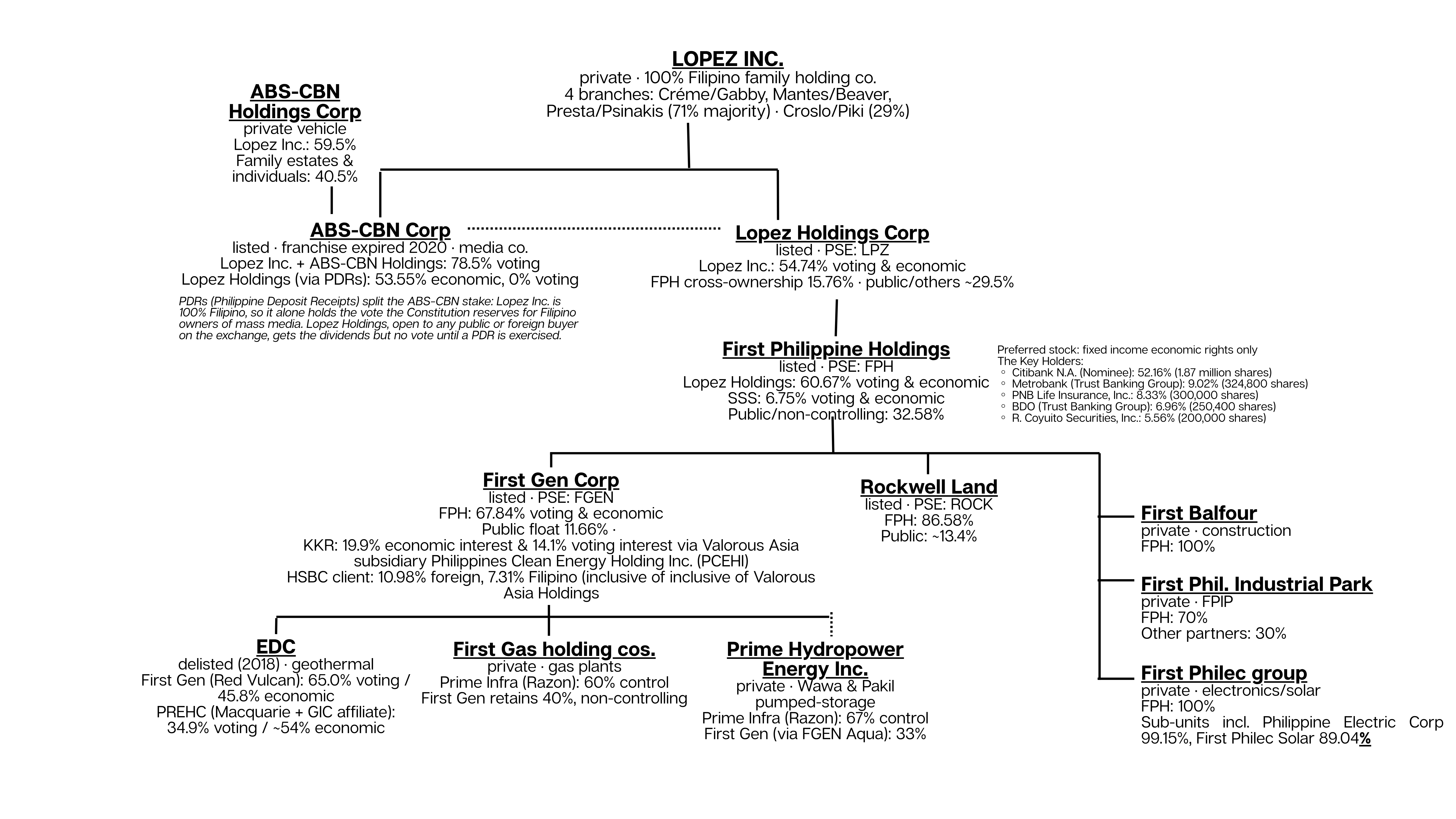
Lopez Inc. is the apex, and it is deliberately private: an unlisted holding company owned by the four family branches, the estates and heirs of Eugenio Jr., Oscar, Presentacion, and Manuel. It holds 54.74% of Lopez Holdings Corporation, votes and economic interest moving together since these are ordinary common shares. Lopez Holdings holds 60.67% of First Philippine Holdings. FPH holds 67.84% of First Gen Corporation. And First Gen, through its holding vehicle Red Vulcan, holds 65% of the vote in Energy Development Corporation, though at that last link the votes and the economics start to pull apart, which matters enough to come back to on its own.
Multiply the chain and the majority cousins’ actual economic claim on First Gen’s cash flow shrinks to somewhere near 22% to 23%, even though their bloc at Lopez Inc. still decides, at every link, who sits on the board above it. That gap between a shrinking economic claim and an intact chain of votes is the entire logic of building a pyramid in the first place, and it is also why the current fight is happening at the Lopez Inc. level rather than at First Gen’s own annual meeting. The 71% majority controls Lopez Inc. outright. But Lopez Inc. only controls Lopez Holdings, which only controls FPH, which only controls First Gen, and the majority’s actual voting power arriving at First Gen’s own shareholder meeting is diluted at every one of those steps. That is why removing Piki at the top has not automatically removed him at the bottom.
Why some shareholders get economic rights but no vote
A share does not have to carry both rights bundled together, and the Lopez Group uses that fact deliberately at two points in the tree.
At EDC, the split runs through the two vehicles that own its stock. Red Vulcan, First Gen’s vehicle, carries 65% of the vote but only 45.8% of the economics. PREHC, the vehicle jointly owned by Macquarie and Singapore’s GIC, holds close to 35% of the vote and roughly 54% of the economics. Two large institutional investors put in the capital that funds most of what EDC does, and in exchange, First Gen kept the votes that decide how it is run. The mechanism here is contractual: a shareholders’ agreement that allocates board seats and voting control out of proportion to the smaller economic stake.
ABS-CBN is where the split is starkest, and it answers a question that comes up constantly in this coverage: why does Lopez Inc. hold nearly all the voting power in ABS-CBN Corp, while Lopez Holdings, one tier up in every other part of the tree, holds none. Lopez Inc., together with ABS-CBN Holdings Corp, a private vehicle it owns 59.5% of, controls roughly 78.5% of the vote at ABS-CBN. Lopez Holdings has a 53.55% economic interest and zero votes.
The mechanism is an instrument called a Philippine Deposit Receipt, or PDR. Lopez Inc. legally owns the underlying ABS-CBN shares and has issued PDRs against them in favor of Lopez Holdings. A PDR passes along the economic upside, the dividends, without passing along the vote, which stays with Lopez Inc. until the PDR is actually exercised. The reason this exists at all traces back to the Constitution, which restricts mass media ownership to entities and individuals that are 100% Filipino, full stop. Lopez Inc., privately held by Filipino family branches, clears that test cleanly. Lopez Holdings, open to any investor on the exchange, foreign funds included, cannot itself hold voting shares in a media company without risking a constitutional problem the moment a foreign shareholder buys in. The PDR threads that needle: Lopez Holdings and its own public shareholders still get the economic benefit of owning ABS-CBN, while the vote that the Constitution reserves for Filipinos alone stays locked inside the entity at the very top of the tree.
Why each company still runs its own board
Every company in this tree, Lopez Holdings, FPH, First Gen, ABS-CBN, EDC, is a distinct legal person with its own board and its own fiduciary duty, one that runs to the company and to all of its shareholders, not to whichever entity happens to hold the most votes. A majority shareholder elects that board and sets broad direction. It does not get to instruct the board on individual transactions, and that limit is precisely what has made the current fight so hard to resolve cleanly. The 71% majority controls Lopez Inc. outright and can remove whoever sits in its presidency. But First Gen’s own board, which includes independent directors with no financial ties to the family, answers to First Gen’s full shareholder base, retail investors, pension funds, and institutional holders like KKR, not to Lopez Inc.’s internal vote. Building the group this way protected the family from outside raiders. It also means the family cannot treat the layers below Lopez Inc. as extensions of itself, and that tension, not any single personality, is the structural core of the story.
The financing payoff
Because votes and economics can be separated at any tier, the group has repeatedly raised large sums without disturbing who runs what. Benpres’s 1993 listing raised roughly P3 billion for 18% of the company, the founding template. First Gen’s 2006 IPO sold common shares to the public while FPH kept its majority and its board seats. A 2010 rights offering pulled in P15 billion, with FPH exercising its own pro-rata rights so its ownership barely moved. A 2012 preferred share issue raised another P10 billion using an instrument that carries limited or no vote by design, precisely so new capital could come in without touching anyone’s control of the board. And in 2017, EDC’s largest capital event of all: Macquarie and GIC, through PREHC, paid to acquire nearly half of EDC’s economic stock, injecting billions into the geothermal business, while First Gen restructured through Red Vulcan specifically to hold onto 65% of the vote. Each of these events did the same underlying thing. New money came in from public markets or global institutional partners in exchange for a slice of the cash flow. The vote, and with it the board, stayed exactly where the family had put it, all the way back to Lopez Inc.
Where this sits among the world’s other family towers
The Lopez structure is not an outlier. It is a Philippine expression of a pattern that shows up wherever a founding family wants to keep control of a business too large to fund from a single family balance sheet. Academic researchers who mapped corporate ownership around the world, most notably the studies led by economists Rafael La Porta and Simon Djankov in the late 1990s and early 2000s, found that pyramidal structures, holding companies stacked on holding companies, and dual-class shares are the two dominant tools families use to hold onto control while owning a shrinking slice of the actual cash flow, and that both tools are especially common in East Asia. The Lopez Group sits squarely inside that pattern. What differs from country to country, and even from conglomerate to conglomerate within the Philippines, is which tool a family reaches for, and how far it pushes it.
The Philippines alone has room for four distinct answers to that question, and the country’s other big family conglomerates each picked a different one.
Ayala runs the shallowest version of the pyramid model. The Zóbel de Ayala family controls Ayala Corporation through a single private holding vehicle, Mermac Inc., which owned a bit under half of Ayala Corporation’s common shares as of the most recent disclosures. There is no PDR-style split of voting from economic rights, and no multi-tier cascade the way the Lopez Group runs one: it is Mermac at the top, Ayala Corporation as the single listed layer, and the operating businesses, Ayala Land, Bank of the Philippine Islands, Globe Telecom, sitting underneath as separate listed companies in which Ayala Corporation itself holds a controlling stake. Call this a two-tier pyramid: one private apex, one listed operating layer, done. The family gets a comparable degree of control with two fewer layers than the Lopez Group needs to reach First Gen, largely because Ayala never had to solve ABS-CBN’s specific problem, a constitutionally restricted asset that only a 100% Filipino entity may vote.
San Miguel Corporation runs the same two-tier shape, but the apex itself is publicly listed rather than a private family vehicle. Top Frontier Investment Holdings, San Miguel’s controlling shareholder, owns roughly 62% of SMC and is itself listed on the PSE, so control here does not rest with one family the way it does at Lopez or Ayala. It rests with a sponsor group assembled in 2008 specifically to consolidate San Miguel’s shares and keep them out of a hostile buyer’s hands: Iñigo Zobel, a member of the extended Ayala clan, holds Top Frontier’s largest single stake at roughly 53%, while Ramon Ang, who runs both Top Frontier and SMC day to day as chairman and chief executive of each, holds only a small direct position but exercises the operational control that comes with running both companies. It is worth being precise about that distinction, because it is easy to shorthand this structure as “Ang’s San Miguel” when the ownership and the operating control actually sit with two different people.
SM Investments Corporation, the Sy family’s conglomerate, is the one genuine outlier on this list: a single-tier, flat structure with no private apex company at all. SMIC’s own 2025 annual report shows why. There is no Sy family holding company sitting above SMIC the way Lopez Inc. sits above Lopez Holdings or Mermac sits above Ayala Corporation. Instead, the family’s roughly 44% stake is scattered directly across SMIC’s own share register, split among individual Sy siblings, Harley, Herbert, and Hans Sy each hold 7% or more on their own, and more than a dozen small family holding corporations and foundations, Syntrix, Tansmart, Sysmart, Green Doe, and others, none of which individually holds more than 4%. SMIC then directly owns its major businesses in a single step, no intermediate layer: roughly half of SM Prime Holdings, more than three-quarters of SM Retail, and just over 45% of BDO Unibank. The family gave up the tidiness of a single controlling vehicle, and in exchange built a structure with one less layer for a hostile buyer, or a journalist, to have to unwind.
The Salim family’s Philippine holdings run the deepest pyramid outside the Lopez Group itself, and it now has one fewer layer of public scrutiny than it used to. The Indonesian Salim family, through First Pacific Company, listed in Hong Kong and roughly 46% family-owned, has long controlled Metro Pacific Investments Corporation, the Philippine holding company that in turn controls Meralco, Maynilad, and the country’s major toll road network. MPIC was itself PSE-listed until a tender offer took it private in late 2023, which means the Philippine operating layer of this particular pyramid no longer files the disclosures a PSE listing requires. The shape is the same as the Lopez Group’s, family apex, offshore or onshore holding company, Philippine operating layer, but one of the middle rungs has gone dark.
Enrique Razon’s businesses are not a pyramid at all, which is its own kind of answer. ICTSI, the ports operator, Bloomberry Resorts, the casino operator, and Prime Infrastructure Capital, the energy and water business now doing the two biggest deals in this series, are three separate companies, two listed and one private, each directly controlled by Razon or by one of a scatter of personal holding vehicles he uses interchangeably, Razon & Co., Quasar Holdings, Prime Strategic Holdings, and others. None of the three sits above or below the other two. There is no equivalent of Lopez Inc. or Mermac holding all three together. Call it a parallel-hub structure: separate businesses under one controlling individual rather than one holding company controlling several businesses. It is a useful contrast precisely because Razon is now a direct counterparty to First Gen in the disputed gas and hydropower deals at the center of this series, and because he has been named, on unverified single-source reporting, as a possible buyer of the majority cousins’ own stake in Lopez Inc. A parallel-hub owner acquiring a stake in a pyramid would be a genuinely new shape for this group, not just a change of face at the top.
In Korea, the chaebols push the pyramid logic much further, and in a different shape. Where the Lopez tree runs in a straight line down, one company owning the next, Korean conglomerates like Samsung have historically relied on circular shareholding: Samsung Life Insurance held shares in Samsung Electronics, which in turn held shares in other Samsung affiliates, in a loop rather than a ladder. The effect is similar, control that vastly exceeds ownership, sometimes with founding families holding well under 10% of a group’s total equity while still deciding who runs every company inside it, but the mechanism is structurally more opaque than a pyramid, which is exactly why Korean regulators have spent the past decade pressuring chaebols to unwind their circular holdings. The Lopez Group’s structure, whatever else can be said about its disclosure record, is at least legible in a way a circular shareholding web is not: every arrow points in one direction, down.
In Sweden, the Wallenberg family solved the same problem with a completely different instrument: the shares themselves. Rather than building a tower of holding companies, the Wallenberg family’s Investor AB uses dual-class stock outright, Class A shares that carry a full vote and Class B shares that carry a fraction of one, sometimes as little as a tenth. The Wallenberg foundations hold roughly a quarter of Investor AB’s capital and about half its votes, and Investor AB then applies the same trick one level down at the companies it controls, Saab, Electrolux, and others, each of which runs its own A and B share classes. It is the dual-class mechanism the Lopez Group uses only once, inside the ABS-CBN PDR, applied instead as the group’s entire operating model.
In the United States, Ford Motor Company runs a version of the same idea inside a single company, openly, since its 1956 IPO. The Ford family holds Class B shares that carry sixteen votes each, giving the family roughly 40% of the total vote while owning under 2% of the company’s total equity, a wider gap between control and cash-flow rights than anything in the Lopez tree produces at any single tier. American markets accept this arrangement in a way Philippine regulators have never had to formally rule on for the Lopez case, because Ford’s structure is disclosed plainly on the face of its share classes rather than built through a chain of holding companies and a deposit receipt.
In India, the Tata Group solves the problem through philanthropy rather than family estate law. Tata Sons, the unlisted holding company that sits above Tata Motors, Tata Steel, and Tata Consultancy Services, is majority owned not by the Tata family directly but by a set of charitable trusts, which together hold roughly two-thirds of Tata Sons. Tata Sons then holds large, controlling-minority stakes in each of the listed operating companies below it, a pyramid in shape, much like the Lopez Group’s, but with a charitable trust rather than a family branch sitting at the very top of the chain.
What all of these structures share with the Lopez Group is the underlying trade the academic literature keeps identifying: a founding family accepts a shrinking claim on the cash a business generates in exchange for keeping the vote that decides who runs it, and does so specifically to survive pressure a flatter, fully public company could not, whether that pressure is a hostile buyer, an activist fund, or, in the Lopez case twice over, an outright government seizure. What differs is the instrument and the depth: a two-tier private apex at Ayala, a two-tier listed apex at San Miguel, no apex at all at SM, three unconnected apexes at Razon’s businesses, a circular web at Samsung, a share class at Investor AB and at Ford, a charitable trust at Tata, and at the Lopez Group, a five-tier pyramid combined with a deposit receipt built specifically to satisfy a constitutional ownership rule none of the others on this list has ever had to work around.
The same research that documents this trade also documents its cost. A controlling family whose votes exceed its economic stake has, structurally, less of its own money at risk in every decision than a shareholder who owns what he votes, and minority shareholders further down the chain, the retail investors and pension funds holding First Gen or EDC stock, are relying on independent directors and disclosure rules to protect an interest the family’s own incentives do not automatically protect for them. That is not a criticism specific to the Lopezes. It is the general finding wherever this kind of structure exists, and it is also, in the end, the quiet mechanism sitting underneath the loud fight over who gets to run First Gen.
Quick reference
Pyramid structure — a family holds a controlling stake in company A, which holds a controlling stake in company B, which holds a controlling stake in company C, and so on. Control cascades down the chain while the family’s actual economic claim on the bottom company shrinks with every multiplication.
Dual-class shares — a single company issues two kinds of stock, one with a full vote and one with a reduced or absent vote, so a family can raise capital by selling the low-vote class to the public while keeping the high-vote class for itself. Used directly by Investor AB and Ford; used only once in the Lopez Group, embedded inside the ABS-CBN PDR arrangement.
PDR (Philippine Deposit Receipt) — a Philippine instrument that transfers the economic benefit of owning a share, dividends and eventual proceeds, without transferring the vote, which stays with the original shareholder until the PDR is exercised. The Lopez Group’s specific tool for letting a publicly listed company, Lopez Holdings, share in ABS-CBN’s economics without breaching the constitutional rule that only 100% Filipino entities may control mass media.
Circular shareholding — several companies within one group each own shares in one another, forming a loop rather than a one-directional chain. The Korean chaebol variant of the same control-without-ownership trade, currently being unwound under regulatory pressure.
Voting rights vs. economic rights — voting rights decide who sits on the board and who runs the company. Economic rights determine who receives the dividends and the proceeds if the company is sold. A shareholder can hold one without the other, and every structure on this list exists to make that split possible.
Deep pyramid — four or more tiers of holding companies between the controlling family and the operating businesses at the bottom. The Lopez Group and the Salim family’s Philippine holdings (First Pacific down through MPIC) both run this shape.
Two-tier pyramid — a single apex company, private or listed, sitting directly above one main listed operating conglomerate, with no further layer in between. Ayala and San Miguel/Top Frontier both run this shape, one with a private family apex, the other with a listed one controlled by a sponsor group.
Single-tier flat — no separate apex company at all. The controlling family holds its stake directly in the operating conglomerate’s own share register, usually spread across several individual family members and small holding vehicles rather than concentrated in one. SM Investments Corporation is the clearest Philippine example.
Parallel hubs — two or more separately controlled companies under one individual or family, with no holding company linking them together. Enrique Razon’s ICTSI, Bloomberry, and Prime Infrastructure Capital are three independent hubs rather than tiers of a single pyramid.


Leave a comment