On the morning of July 1, 1916, the British Army launched what it believed would be the decisive blow of the First World War. For seven days before the assault, British artillery had pounded German lines along the Somme River in northern France, nearly 1.5 million shells meant to cut the barbed wire and destroy the fortifications before the infantry even moved, and the generals were confident they would break through by nightfall.
Instead, 19,240 British soldiers died before the day was out, the single bloodiest day in British military history. The German lines held. The artillery had not destroyed the fortifications; it had merely announced that an attack was coming. The German soldiers retreated into deep underground bunkers, waited for the shelling to stop, and emerged to cut down the advancing infantry with machine guns.
By the end of the Somme campaign, four and a half months later, the British had gained about seven miles of territory at a cost of roughly 420,000 casualties.
This is what trench warfare looks like: two sides dug into opposing positions, neither able to advance decisively, both pouring resources into holding a line and into making the other side bleed, not through maneuver or breakthrough but through attrition, winning not by outflanking the enemy but by outlasting them.
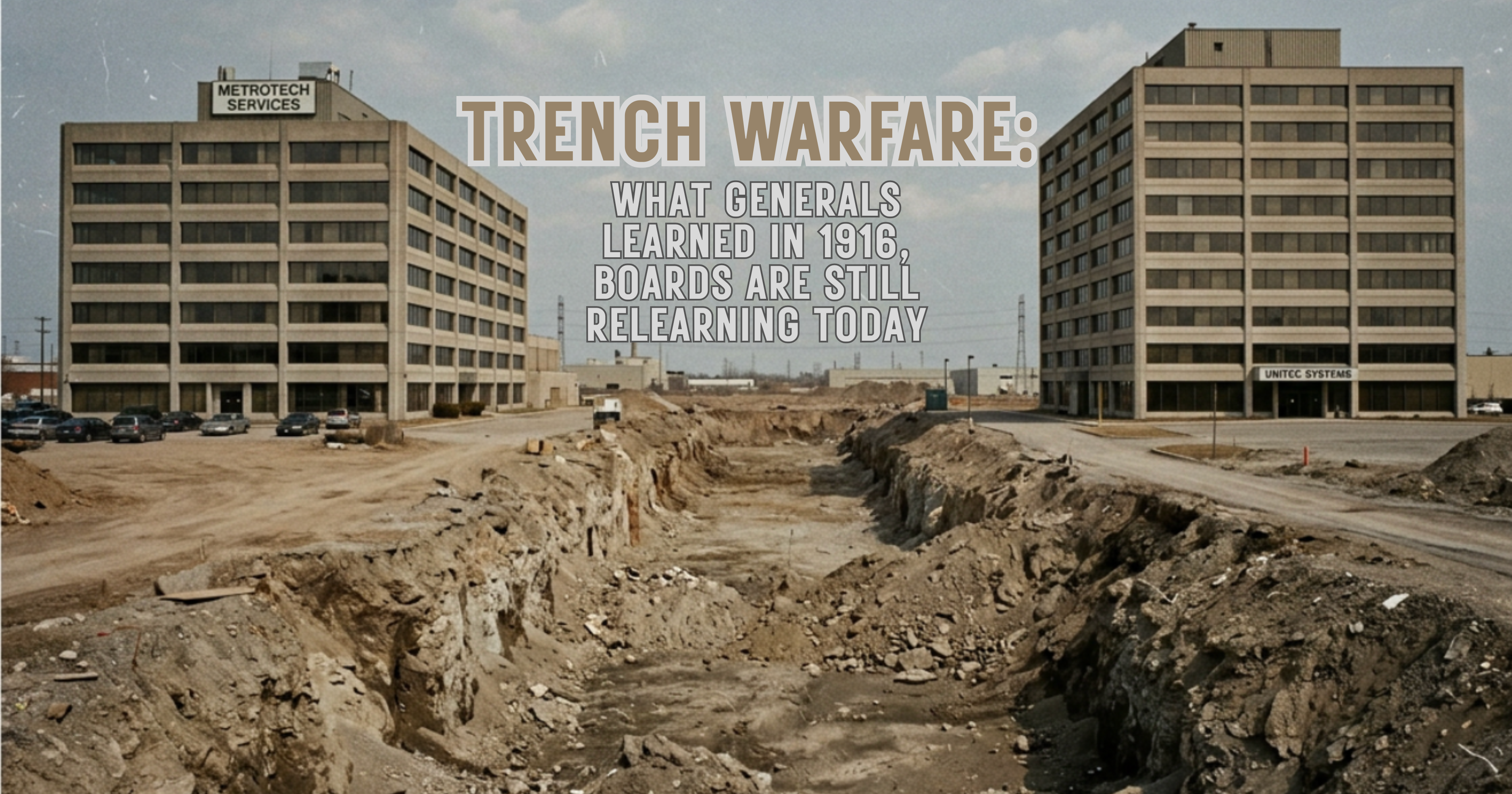
Military historians have long studied why trench warfare emerges and how it ends, and so have business strategists, organizational psychologists, and conflict scholars, because the pattern does not stay on battlefields; it shows up in boardrooms, family holding companies, labor negotiations, and political standoffs with striking regularity, under different names but with the same recognizable shape. The Somme illustrates the failed breakthrough; Verdun, running simultaneously and at comparable cost, illustrates the thing itself in its purest form, two armies grinding each other down for ten months with no objective beyond survival.
What makes the trench warfare phase particularly relevant to how businesses and families in business behave during crisis is that it describes not a strategy chosen but a condition fallen into: the moment when both parties have tried and failed to win quickly, when the easy moves have been exhausted and what remains is the grinding, expensive work of holding position while watching for the other side’s weakness.
Crises in business rarely begin in the trenches; they arrive there after the opening salvos have failed, after the board meeting that settled nothing, after the press release that only hardened the other side, after the legal filing that produced a counter-filing.
The anatomy of the trench
Before we get to the case studies, it helps to name the features that define this phase of a conflict, because trench warfare is not simply a long fight. It has a specific structure.
Mutual entrenchment. Both parties have fortified positions that are costly to overrun directly. In a corporate war, this might mean one side controls the listed operating company while the other controls the private holding above it, or a union has strike leverage while a company holds lockout rights, and neither can simply charge the other’s position without absorbing enormous losses.
Attrition over breakthrough. The goal shifts from winning outright to making the other side’s position too expensive to maintain, so that you are no longer trying to knock your opponent out but trying to drain them financially, politically, psychologically, reputationally.
Indirect fire. In actual trenches, you did not charge the enemy directly; you used artillery to weaken them from a distance before any advance, and in business conflicts the artillery equivalents are regulators, courts, institutional investors, media, and public opinion, all aimed at the other side from a safe remove.
High cost, slow movement. Every press release, legal filing, proxy solicitation, and public complaint costs money and management attention while gaining little immediate ground, but the cumulative drain matters, which is why trench warfare, expensive as it is for both sides, eventually ends.
The protected center. Each side has something it will not surrender: a position, an asset, a principle, a source of legitimacy. In WWI, both sides had held their trenches so long that retreating meant admitting the previous years’ deaths had been for nothing. Sunk cost becomes fortification.
Three wars that looked like business
1. The Ambanis: when the family is the battlefield
When Dhirubhai Ambani, founder of Reliance Industries, India’s largest private corporation, died in July 2002 without a will, he left behind two sons and no instructions for who would get what.
Mukesh, the older, was the builder, the numbers man, the one who had expanded Reliance’s petrochemicals empire. Anil, the younger, was the dealmaker, the face, the one who wanted to take the company into financial services and telecommunications.
For two years, they managed an uneasy peace, but in November 2004 their conflict broke into public view through competing statements, competing board maneuvers, competing visions for which direction Reliance would go. The Indian financial press covered it daily, and shareholders watched the stock with anxiety. The lenders, the employees, and the Bombay Stock Exchange were all watching.
Neither brother could simply remove the other. They were co-inheritors of a structure that Dhirubhai had never formally divided, and the family’s holding was split in ways that made any unilateral move complicated, with the operational companies carrying cross-dependencies and every stakeholder on high alert.
What ended it was not a decisive battle but a negotiated partition brokered in June 2005 by their mother, Kokilaben Ambani. Mukesh took Reliance Industries, including the petrochemicals, refining, and core energy operations, while Anil took Reliance Capital, Reliance Communications, Reliance Energy, and Reliance Infrastructure: two separate empires carved from one original.
The textbook resolution was a managed partition brokered by a neutral party, triggered by the shared recognition that the war was damaging the thing both sides were fighting for. The Reliance share price had been volatile throughout, institutional investors were openly frustrated, and the family brand built over decades by Dhirubhai was being spent down in public squabbling.
When the cost of fighting exceeds the value of what you’re fighting over, someone finds a way to the table.
The coda, though, is instructive: the partition ended the open warfare but not the underlying tensions, and subsequent years brought legal skirmishes over gas pricing and non-compete agreements. More telling still, Anil’s half of the empire eventually collapsed under debt in the late 2010s, illustrating that a structured partition does not guarantee the survival of both sides equally. What looks like the second ending can quietly become the fifth one.
2. Carl Icahn: attrition as a business model
Carl Icahn did not become one of the most feared investors in American corporate history by winning clean victories. He became feared because he understood trench warfare better than his opponents did, and unlike them, he wanted to be in the trenches.
The playbook he refined across decades of corporate raiding and activist investing is essentially a manual in strategic attrition: find a company with undervalued assets and entrenched management, buy a significant stake, make noise, demand board seats, asset sales, buybacks, or management changes, and if the company resists, escalate with more shares, public letters, proxy fights, and media campaigns.
The genius of it is that Icahn never necessarily needs to win the battle outright; what he needs is for the fight to cost the other side more than it costs him. Time Warner’s management spent years and hundreds of millions in legal fees and management energy fighting off his 2006 campaign for a breakup of the company, and they did not give him everything he wanted, but they gave him enough, including a $20 billion buyback, board changes, and cost-cutting commitments, that he eventually declared a partial victory and reduced his position.
He did not charge the trench; he shelled it until the defenders decided the cost of holding was too high.
The lesson Icahn demonstrated, one that business school professors have since formalized, is that in a protracted conflict with entrenched parties, the winner is often not whoever has the strongest position but whoever has the higher pain tolerance and the lower cost structure for continuing the fight. Management was spending corporate resources that did not belong to them personally, while Icahn was spending his own money on a bet he had already stress-tested.
3. Samsung: when the external world ends the trench
The Samsung governance crisis of 2015 to 2017 is a case study in how trench warfare ends not with one side winning but with an outside force breaking the stalemate entirely.
The immediate battle was over the merger of Samsung C&T and Cheil Industries, a transaction critics argued was structured primarily to benefit Lee Jae-yong’s succession to control of the Samsung empire at below-market terms for ordinary shareholders. The U.S. hedge fund Elliott Management, a shareholder in Samsung C&T, opposed the merger and launched a public proxy campaign. For months, the two sides fought across press releases, regulatory filings, and shareholder communications, with Elliott holding the governance argument and Samsung holding the political relationships and the weight of national economic significance, given that the company is so large in South Korea that the Korean won has at times moved with its share price.
The merger passed narrowly, partly because the National Pension Service of Korea, the country’s largest institutional investor, voted for it, a vote that later became the center of a corruption investigation. The special prosecutor found evidence that Samsung had paid for the NPS vote through donations to entities linked to the woman at the center of the “Chaebol Gate” scandal that eventually brought down President Park Geun-hye. Lee Jae-yong was convicted and imprisoned, later pardoned in 2022 on grounds of national economic necessity, Samsung restructured its governance, and Elliott eventually sold its position at a profit.
The trench warfare between Elliott and Samsung was never truly resolved by either side’s strength but was overtaken by a political scandal that reorganized the entire playing field. Neither side chose this ending.
How to know when you’re in it
Conflict enters the trench warfare phase when three things are simultaneously true: neither side can deliver a decisive blow without catastrophic cost; both sides have dug into positions they are not willing to abandon; and the secondary costs to employees, investors, lenders, customers, and the institution itself are visibly accumulating.
The signals are recognizable once you know what to look for: press releases stop being about substance and start being about positioning, the goal of each statement shifting from persuasion to record-marking; lawyers begin appearing where there were only executives; regulators start receiving letters; and third parties who wanted nothing to do with the dispute find themselves named, claimed, or implicated.
And crucially, the thing being fought over starts to show the damage, as share prices drift, employees begin updating their résumés, partners grow careful about which side of the line they’re seen on, and lenders start asking questions.
What ends trench warfare
History offers roughly five endings, and they are not equally pleasant.
The first is mutual exhaustion, in which both sides run out of the resources or will to continue and a negotiated settlement follows. The Ambani model: costly, but the empire survives, divided.
The second is structured partition, in which assets or authority are formally divided and each side goes its separate way, which requires a neutral party willing to broker the agreement and both sides willing to accept less than they originally wanted.
The third is decisive asymmetric attrition, in which one side bleeds out faster than the other, producing a winner, though rarely the one you would have expected at the beginning.
The fourth is an external catalyst, in which something outside the conflict resets the terms entirely, as when a regulator acts, a lender calls a loan, or a political shift changes who has protection; this is the Samsung model, and neither side chose it.
The fifth is prolonged decline, in which neither side is willing to settle, no external force intervenes, and the institution being fought over simply deteriorates until there is nothing left worth fighting for. It’s, an ending everyone in a trench war believes is reserved for the other side, though it sometimes becomes everyone’s.
Now back to the WWI trenches.
The Western Front did not move for four years. When Germany finally collapsed in November 1918, it was not because the British or French had found a brilliant new way to break through but because Germany’s home front, politically fractured, economically strangled by the naval blockade, and exhausted by years of sacrifice, could no longer sustain the fight.
The armistice was signed not on a battlefield but in a railway carriage in the forest of Compiègne.
Both sides had thought they were fighting over France, but by the end, they were fighting for the right to stop.
Sources:
On the Battle of the Somme John Keegan, The First World War (Knopf, 1998). The primary reference for the July 1, 1916 casualty figures, the artillery count, and the territorial gains at the Somme campaign’s end.
On Verdun as the paradigmatic attrition battle Alistair Horne, The Price of Glory: Verdun 1916 (Macmillan, 1962; Penguin reprint, 1993). The standard account of Falkenhayn’s stated strategy of “bleeding the French Army white.”
On Clausewitz and the theory of attrition Carl von Clausewitz, On War (1832; Princeton University Press translation by Michael Howard and Peter Paret, 1976).
On the Ambani brothers dispute and partition Hamish McDonald, Ambani and Sons (Lotus Roli, 2010). Supplemented by contemporaneous reporting in the Economic Times and Business Standard (India), 2004–2005.
On Carl Icahn and the Time Warner campaign Mark Stevens, King Icahn: The Biography of a Renegade Capitalist(Dutton, 1993), for the broader Icahn playbook. The 2006 Time Warner campaign details, including the $20 billion buyback settlement, are drawn from contemporaneous reporting in The Wall Street Journal and The New York Times.
On Samsung, Elliott Management, and the NPS Contemporaneous reporting in The Wall Street Journal, Financial Times, and Korea JoongAng Daily, 2015–2017. Lee Jae-yong’s conviction (2017), acquittal on appeal (2019), re-conviction (2021), and pardon (2022) are matters of public record reported across international wire services.
On attrition warfare as business strategy Farnam Street, “Attrition Warfare: When Even Winners Lose” (October 2019). Available at https://fs.blog/attrition-warfare/


Leave a Reply